

On the following subject: Dynamics and distribution of marine mercury species.
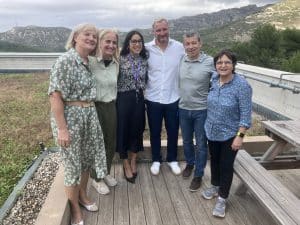
Members of the jury
- Lars-Eric HEIMBURGER-BOAVIDA - Aix Marseille University, France - Director of These
- Gaël ERAUSO - Aix Marseille University, France - Chairman of the Jury
- Mrs Milena HORVART - Institut Jožef Stefan, Slovenia - Thesis co-supervisor
- Mrs Paraskevi NOMIKOU - National and Capodistrian University of Athens, Greece - Examiner
- Mrs Mathilde CANNAT - CNRS, France - Rapporteur
- Mr Daniel COSSA - Université Grenoble Alpes, France - Rapporteur
Abstract
Mercury is a pollutant that poses a threat to humans and ecosystems around the world. The United Nations Minamata Convention on Mercury, in force since 2017, aims to protect public health and the environment from the toxic effects of mercury. To achieve the objectives of the convention, a general understanding of the global mercury cycle is required. The oceans are under-studied when it comes to mercury. To date, only 5,804 measurements of THg mercury in seawater have been made worldwide, with a much smaller number of measurements for various other species, around 2,400. Despite being the third largest ocean basin, only 5 mercury measurements have been made in the Indian Ocean. In this paper, we present mercury speciation data from a transect during a GEOTRACES oceanographic mission covering most of the southern Indian Ocean. We combined measurements of mercury in seawater, particles, sediments, aerosols and rain to calculate fluxes between the atmospheric, oceanic and seafloor compartments. High escape rates are only observed in areas under the influence of the Agulhas Current. Our results reveal a significant imbalance between dry and wet deposition, escape and vertical export fluxes at the southernmost stations, indicating that the Indian sector of the Southern Ocean may act as a mercury sink. In recent decades, anthropogenic sources of mercury have been well quantified. However, the contribution of natural sources to the global mercury cycle remains uncertain. The Minamata Convention on mercury provides for the monitoring of mercury levels in the environment, and the quantification of natural sources is essential for measuring the anthropogenic footprint. Natural sources include terrestrial volcanism, emissions from enriched soils and undersea hydrothermal sources. The impact of hydrothermal vents and volcanism remains largely unknown. We present mercury measurements in hydrothermal vent fluids, plume waters, seawater, biota, particulates and sediments from five submarine volcanic sites. Our results indicate relatively constant mercury concentrations in hydrothermal fluids across mid-ocean ridges, in contrast to those found in arc volcanoes. Using a dilution model, we have established that mercury of hydrothermal origin behaves in a quasi-conservative manner once it is released. We are able to detect traces of hydrothermal mercury hundreds of kilometres away and in distant sediments. Scaling up our results, we propose a flow of mercury from hydrothermal vents in both arc volcanoes and mid-ocean ridges, which together account for the majority of submarine hydrothermal vents.

