



News CNRS Earth & Universe
Thanks to a novel approach, an international team led by scientists from CNRS Terre & Univers has been able to quantify the distinct role of micro-organisms, whether free or attached to particles falling along the water column, in the carbon cycle of the mesopelagic zone (100 to 1000 m depth). Published in Nature Geoscience, this study offers a new perspective for understanding how microbes influence the ocean carbon cycle. By revealing the impact of physical structures (cyclonic and anticyclonic eddies, oceanic fronts, visible at the surface via satellite images) on the fluxes of micro-organisms, this study makes it possible to better estimate the oceanic carbon balance and to refine climate models by integrating these physical and microbial processes, which have hitherto been underestimated.
CNRS laboratories involved
- Mediterranean Institute of Oceanology (MIO - Pythéas)
Supervisory bodies: CNRS, Aix-Marseille University, IRD, University of Toulon - Oceanology and Geosciences Laboratory (LOG)
Supervisory bodies: CNRS, Université Littoral Côte d'Opale, Université de Lille - Marine Environment Sciences Laboratory (LEMAR - IUEM)
Supervisory bodies: CNRS, IFREMER, IRD, UNIV BRETAGNE OCCIDENTALE - Villefranche oceanography laboratory (LOV - IMEV - STAMAR)
Supervisory bodies: CNRS, Sorbonne University - Microbial Oceanography Laboratory (LOMIC)
Supervisory bodies: CNRS, Sorbonne University - INSU Technical Division (DT INSU), CNRS, National Oceanographic Instrumentation Park
Read the news
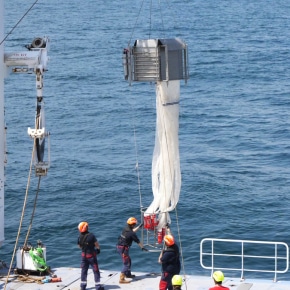
Launching of the “Multinet HYDROBIOS” net during the APERO campaign(© Melvak / Mission APERO / CNRS Images)