



The launch of the Franco-American SWOT (Surface Water and Ocean Topography) satellite is scheduled for Friday 16 December 2022 from the Vandenberg base in California to 12h46 CET (3h46 Pacific Standard Time).
This international CNES and NASA will provide high-definition data on fresh and salt water over 90% of the Earth's surface. The data obtained by SWOT will be compared with that collected in 2023 during the oceanographic campaign BioSWOT-Med south of the Balearic Islands to try and understand the role of ocean currents in determining the exceptional biodiversity of the Mediterranean.
The SWOT mission will make it possible to see the Earth's freshwater bodies and oceans with a definition rarely equalled, enabling us to understand how the ocean influences climate change and how global warming affects lakes, rivers and reservoirs.
The first six months of the mission include a satellite calibration and validation phase (CalVal), during which the satellite will fly in a one-day repeat orbit with reduced spatial coverage but improved temporal resolution. During this period, SWOT's ascending and descending trajectories will intersect, providing a higher temporal resolution: crossovers. These crossovers represent a unique opportunity to track the rapid evolution of fine-scale ocean dynamics.
" We are eagerly awaiting the launch of SWOT and are very busy preparing for our campaign: organisational meetings are being held to plan operations, prepare tools and load oceanographic equipment on board the research vessel. "says Andrea Dogliolia physical oceanographer at the Mediterranean Institute of Oceanography (MIO) in Marseille and head of mission for the campaign BioSWOT-Med which will take place from 20 April at 15 May 2023 in the south of the Balearic Islands, matching one of SWOT's crossovers.
" The new satellite and its new sensors will enable us to measure sea surface height more accurately, and from this we will be able to improve our estimates of marine currents. With better mapping of currents, we will be able to sample them more effectively and establish the relationships between currents and biological communities. "explains Gérald Grégoria microbiologist at the MIO and co-responsible for the mission of the campaign BioSWOT-Med.
The Mediterranean is an oligotrophic sea (poor in nutrients), but it is home to some of the world's greatest biodiversity. One of the objectives of the mission BioSWOT-Med is to understand the physical processes that structure this biodiversity and which could underlie the wide diversity of marine organisms, from plankton to cetaceans, observed in the Mare Nostrum.
The campaign BioSWOT-Med is one of the 24 oceanographic and hydrological campaigns scheduled during the rapid sampling phase of SWOT, brought together in the the international SWOT-AdAC (Adopt a Crossover) consortium.
The SWOT mission is the result of a collaboration between CNES and NASA, with contributions from the Canadian Space Agency (CSA) and the UK Space Agency. The satellite was assembled, integrated and tested at Thales Alenia Space's facilities in Cannes, France.
To enable as many people as possible to follow the launch of SWOT, CNES is producing a programme to be broadcast on its channels. Twitch and YouTube from 12.15pm.
More information is available on the dedicated CNES website.
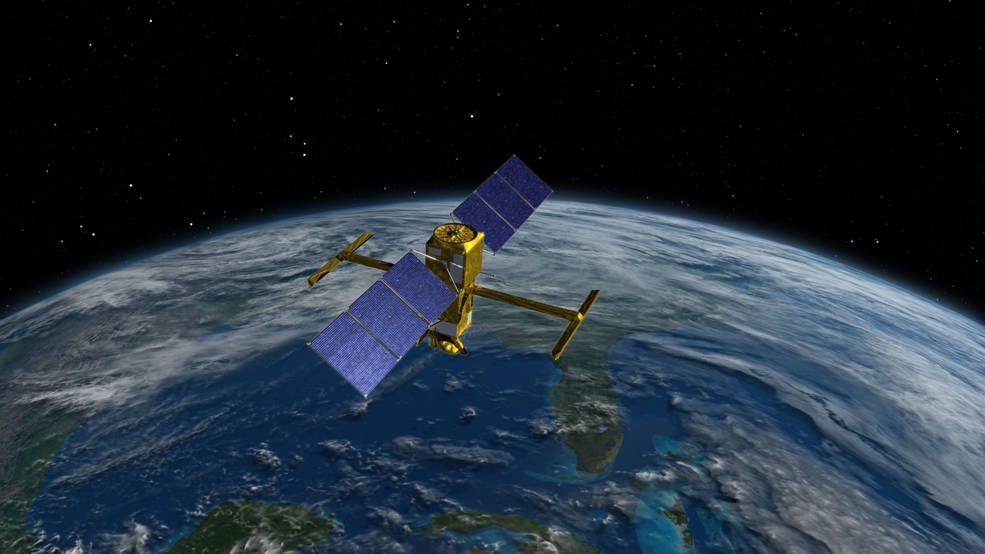
An artist's concept of the SWOT spacecraft. The SWOT mission will measure the height of the world's oceans, rivers and lakes,
helping scientists to measure changes in freshwater and saltwater masses over time. Credits: NASA
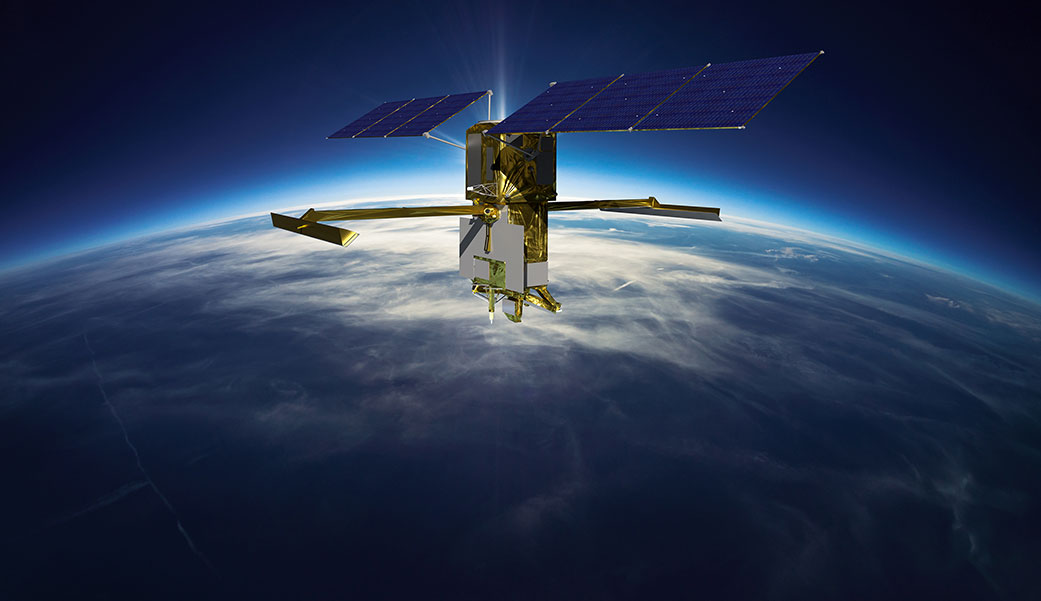
This illustration shows the SWOT (Surface Water and Ocean Topography) satellite in orbit with its solar panels.
and the KaRIn instrument antennas deployed. Credits: CNES