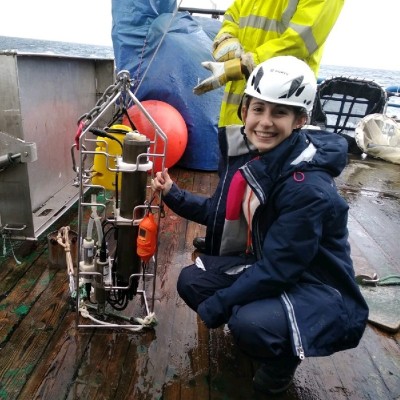




Dr. Irene Nadal-Arizo, jeune chercheuse à l’Université de Málaga, donnera un séminaire à l’Amphithéâtre OCEANOMED, Bâtiment Méditerranée, Campus de Luminy, le jeudi 25 juin 2026 à 11h00 (30 min de présentation & 15 min de questions) sur le thème : Unravelling the physics behind marine life: applied modelling studies in the Mediterranean Sea and Eastern Atlantic Ocean.
Courte biographie
Après avoir obtenu son diplôme en sciences marines, le Dr Irene Nadal-Arizo a soutenu une thèse de doctorat en océanographie physique à l’université de Málaga, où elle a développé un intérêt pour les interactions entre la physique océanique et les écosystèmes marins. Ses travaux de recherche portaient sur l’utilisation de modèles numériques pour étudier le transport, la dispersion et la connectivité en mer, en particulier dans les zones côtières, en appliquant des approches lagrangiennes à différents sujets d’intérêt, notamment les stocks halieutiques, les algues envahissantes et les déchets marins. Plus récemment, elle a étudié comment les changements climatiques liés à la température, aux remontées d’eau et à la disponibilité alimentaire peuvent affecter la répartition, la productivité et la dynamique des petites espèces pélagiques dans le système de remontée d’eau au large de l’Afrique du Nord-Ouest. Elle est actuellement en visite au MIO pendant deux semaines afin de rédiger une demande de bourse postdoctorale MSCA.
Résumé
Hydrodynamic features play a crucial role in shaping the dispersal, connectivity, and population dynamics of marine species. Here we explore how physics-to-biology modelling frameworks can help elucidate the mechanisms by which hydrodynamic processes govern biological outcomes in two environmentally dynamic regions. First, in the Mediterranean Sea, a Lagrangian particle tracking algorithm coupled to a high-resolution hydrodynamic model is used to map dispersal pathways in the Alboran and Adriatic Seas, with applications including fish larvae and invasive macroalgae. Shifting to the Eastern Atlantic, an end-to-end modelling framework coupling ocean circulation, lower-trophic ecosystem and individual-based models is applied to two small pelagic species in the Canary Current Upwelling System, to identify mechanisms by which large-scale climate variability impacts their spatiotemporal dynamics, and to generate future projections of abundance and biomass distribution. Finally, a collaborative project with CNRS-MIO exploring new physics-to-biology frameworks for other commercially important marine species is presented.