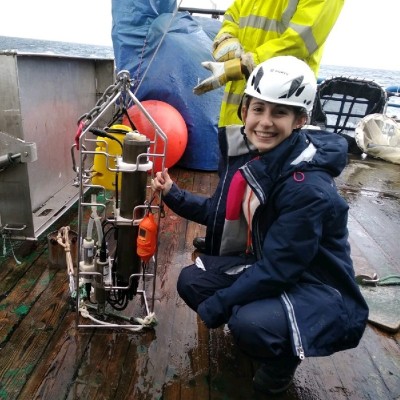




Dr Irene Nadal-Arizo, a young researcher at the University of Málaga, will give a seminar in the OCEANOMED Amphitheatre, Mediterranean Building, Luminy Campus, on Thursday 25 June 2026 à 11h00 (30-minute presentation & 15 minutes of questions) on the topic: Unravelling the physics behind marine life: applied modelling studies in the Mediterranean Sea and the Eastern Atlantic Ocean.
Short biography
After completing her degree in marine sciences, Dr Irene Nadal-Arizo completed a PhD in physical oceanography at the University of Málaga, where she developed an interest in the interactions between ocean physics and marine ecosystems. Her research focused on the use of numerical models to study transport, dispersion and connectivity at sea, particularly in coastal areas, applying Lagrangian approaches to various topics of interest, including fish stocks, invasive algae and marine litter. More recently, she has investigated how climate change—in terms of temperature, upwelling and food availability—can affect the distribution, productivity and dynamics of small pelagic species in the upwelling system off the coast of north-western Africa. She is currently visiting the MIO for two weeks to draft an application for an MSCA postdoctoral fellowship.
Abstract
Hydrodynamic features play a crucial role in shaping the dispersal, connectivity and population dynamics of marine species. Here we explore how physics-to-biology modelling frameworks can help elucidate the mechanisms by which hydrodynamic processes govern biological outcomes in two environmentally dynamic regions. First, in the Mediterranean Sea, a Lagrangian particle-tracking algorithm coupled to a high-resolution hydrodynamic model is used to map dispersal pathways in the Alboran and Adriatic Seas, with applications including fish larvae and invasive macroalgae. Moving to the Eastern Atlantic, an end-to-end modelling framework coupling ocean circulation, lower-trophic ecosystem and individual-based models is applied to two small pelagic species in the Canary Current Upwelling System, to identify the mechanisms by which large-scale climate variability affects their spatiotemporal dynamics, and to generate future projections of abundance and biomass distribution. Finally, a collaborative project with CNRS-MIO exploring new physics-to-biology frameworks for other commercially important marine species is presented.