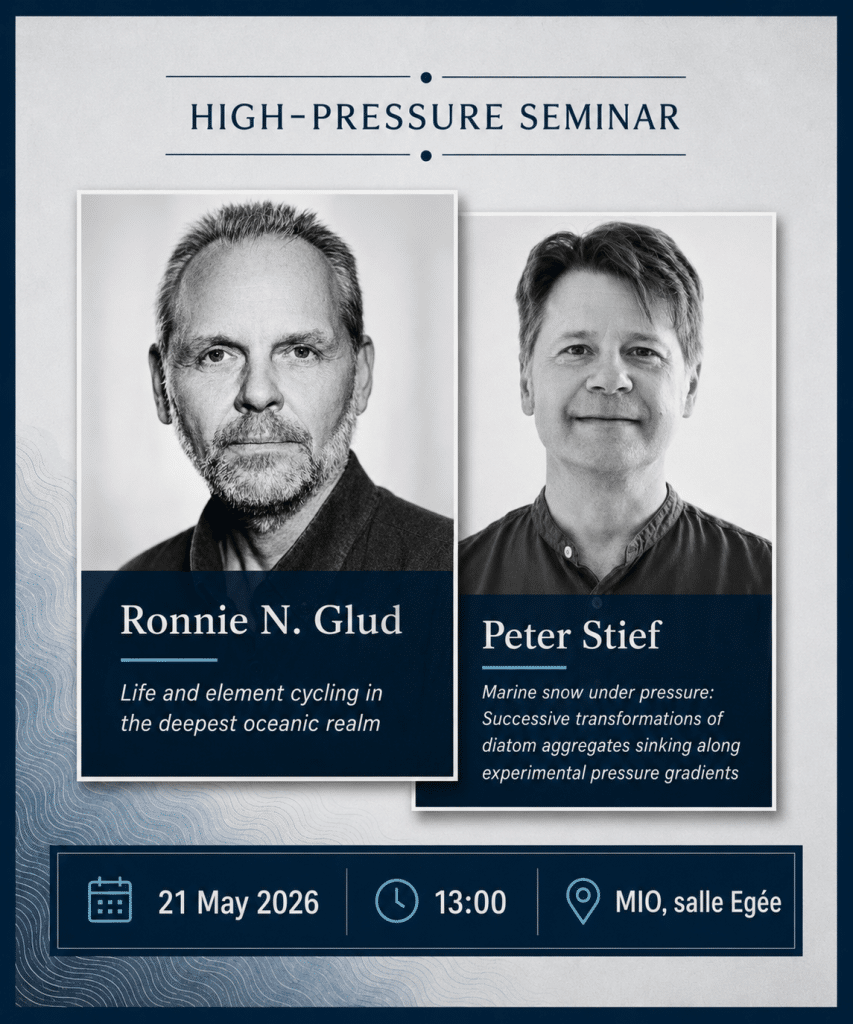




We Thursday, 21 May at 13:00, in the Salle Egée at MIO, Ronnie N. Glud and Peter Stief, from the HADAL group at the University of Southern Denmark, will present their work during a special joint seminar.
Salle Egée & Zoom link
The seminars will be held in English. There will be two full days of scientific discussion with Ronnie and Peter at MIO on Thursday 21st, and at CEREGE on Friday 22, to encourage collaboration between our institutes. If you would like to take part in these discussions, please contact the organisers Christian Tamburini or Olivier Sulpis.
We hope to see lots of you there!
Christian & Olivier
Presentation by Ronnie N. Glud
Ronnie N. Glud will give a presentation on " Life and the cycling of elements in the deepest parts of the ocean ".
Abstract : The hadal zone represents the deepest and least explored marine habitat on Earth. The hadal ocean covers more than 2 million km² and comprises 27 long, narrow trench systems that stretch along tectonic subduction zones. Hadal exploration is challenging, but recent technical advances have opened up new possibilities for exploring the deep and have drastically enhanced our understanding of life and biogeochemistry in the deepest part of the ocean.
It has now been documented that trenches act as depocentres for organic material, and they appear to represent globally significant sites of carbon sequestration; at the same time, however, they act as biological hotspots for deep-sea life thriving under extreme hydrostatic pressure. The rate of microbial mineralisation along trench axes is significantly higher than in adjacent abyssal plains, and in the most active trench systems, early diagenesis encompasses the complete redox sequence of anaerobic mineralisation known from coastal sediments. This intensified mineralisation is mediated at extreme hydrostatic pressure by largely unexplored communities, and preliminary investigations suggest that hadal biomes are distinct yet surprisingly diverse. Recent findings also show that trenches act as reservoirs for anthropogenic pollutants and can harbour surprisingly high concentrations of persistent organic pollutants.
Hadal trenches are a unique yet highly dynamic deep-sea environment, and their function or importance cannot be understood by extrapolating our understanding of the surrounding ocean. The presentation will provide an overview of the current state of hadal biogeochemical research and discuss the many unresolved questions and paradigms that will drive hadal research in the coming years.
Presentation by Peter Stief
Then, Peter Stief will present his work on " Marine snow under pressure: Successive transformations of diatom aggregates sinking along experimental pressure gradients ".
Abstract : The best-understood process affecting sinking marine snow particles is their microbial degradation in the surface ocean, which significantly reduces the vertical carbon flux into the deep ocean. In contrast, the fate of particles reaching the high-pressure environment of the deep ocean remains unclear, partly due to methodological constraints. Here, we introduce rotating pressure cylinders in which the continuous increase in pressure experienced by sinking particles can be simulated. Rising pressure levels gradually inhibit microbial respiration and growth associated with fast-sinking diatom aggregates, suggesting that carbon is preserved during the descent to the deep ocean. Dissolved organic carbon leaking from diatom aggregates at high pressure levels remains labile and may therefore contribute to the dissolved organic matter pool of the deep ocean. Pressure incubations of deep-ocean microbial communities reveal their superior carbon mineralisation potential compared to surface-ocean microbial communities. The import of relatively labile organic carbon and colonisation by pressure-tolerant microbes make the deep ocean a site of active carbon cycling.