




Using instrumented underwater gliders, a French research team has identified the area in the Mediterranean where bioluminescence becomes the main source of light. This breakthrough opens up new avenues for the study of marine ecosystems and their interactions with the light environment.
A team of researchers from Aix-Marseille University and the CNRS has, for the first time in the Mediterranean, identified the depth at which light produced by marine organisms becomes more abundant than light of atmospheric origin. This study, carried out as part of the BIOLUMOPS project (Marine Bioluminescence: Spatio-temporal in situ observations using an underwater glider, funded by the Agence Innovation Défense), opens up new insights into underwater light landscapes and their influence on marine ecosystems.
To carry out these observations, the scientists drew on the expertise of the MIO (Mediterranean Institute of Oceanography), the SHOM (Naval Hydrographic and Oceanographic Service) and the company ALSEAMAR to deploy autonomous underwater gliders, «gliders» equipped with sensors measuring both the sunlight penetrating the ocean and the bioluminescence emitted by more than three-quarters of marine organisms. «Gliders have transformed modern oceanography by providing an autonomous platform capable of carrying scientific sensors over long periods, in places where ships can only make occasional observations » Nagib Bhairy, co-author of the study and responsible for the planning, deployment and operation of the gliders.
The surveys, carried out in the Gulf of Lion in the spring and summer of 2025, enabled data to be collected at depths of up to 600 metres – the maximum depth for a sensor. The results of the analysis of this data, carried out by Andrea Hay, a postdoctoral researcher at the MIO, show that this « bioluminescent transition depth »varies considerably throughout the day. Around midday, it is found at depths of between 250 and 450 metres, whereas at midnight, bioluminescence can be most prominent right up to the surface. This dynamic reflects the constant balance between the attenuation of sunlight in the water and the luminous activity of marine organisms.
" Beyond its technological achievements, this discovery sheds new light on the ecological role of light in the ocean. Bioluminescence is, in fact, an essential means of communication, defence or predation for many marine species. Identifying the areas where it becomes visible relative to ambient light provides a better understanding of the behaviour of organisms and the vertical organisation of marine communities over time », adds Séverine Martini, a specialist in bioluminescence and lead researcher on the BIOLUMOPS project. This study also demonstrates the potential of underwater gliders to observe, in high resolution, biological phenomena that are as yet poorly documented. At a time when the ocean’s luminous landscapes are changing as a result of environmental shifts, these new observations provide a valuable tool for better understanding the functioning and evolution of marine ecosystems.
Bibliography : Hay A., Maingot-Lépée J., Petrenko A., Bhairy N., Luneau C., Fuda JL., and Martini S. From atmospheric light to bioluminescence: determining transition depths using gliders in the Mediterranean Sea. Progress in Oceanography, 2026.
Contact : Séverine Martini, CNRS Research Fellow at the Mediterranean Institute of Oceanography (MIO – UMR 7294).
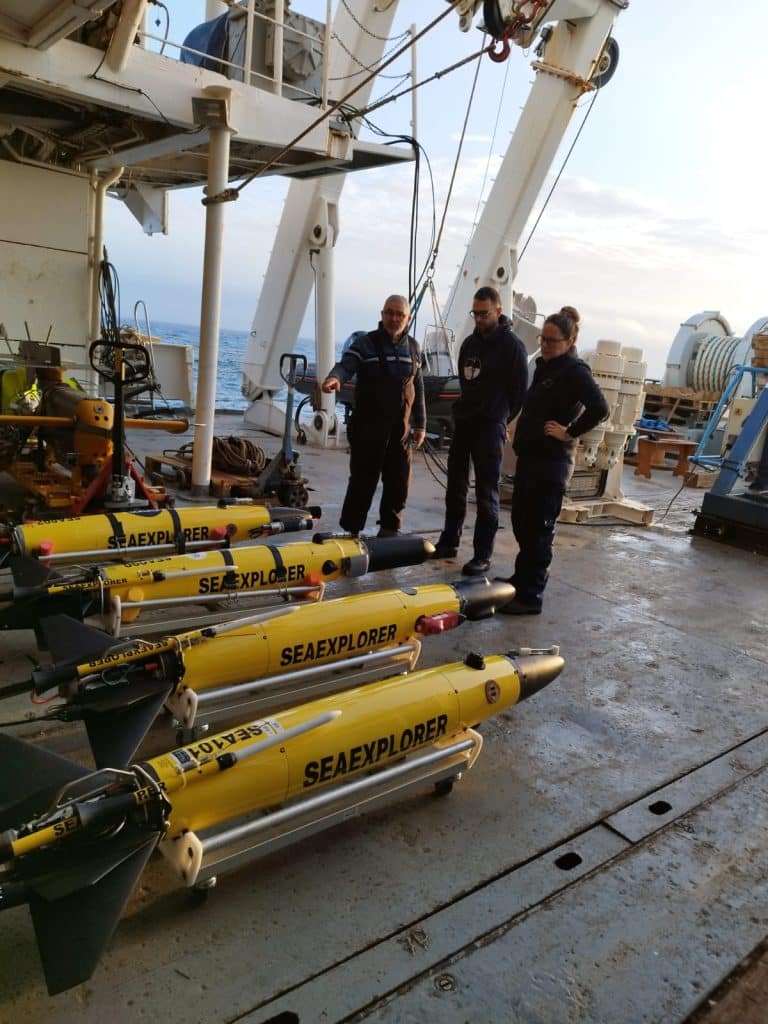
Deployment of a fleet of four gliders in 2025 and 2026 from vessels in the French oceanographic fleet,
in the Mediterranean Sea to observe and record marine bioluminescence in the Mediterranean Sea.