




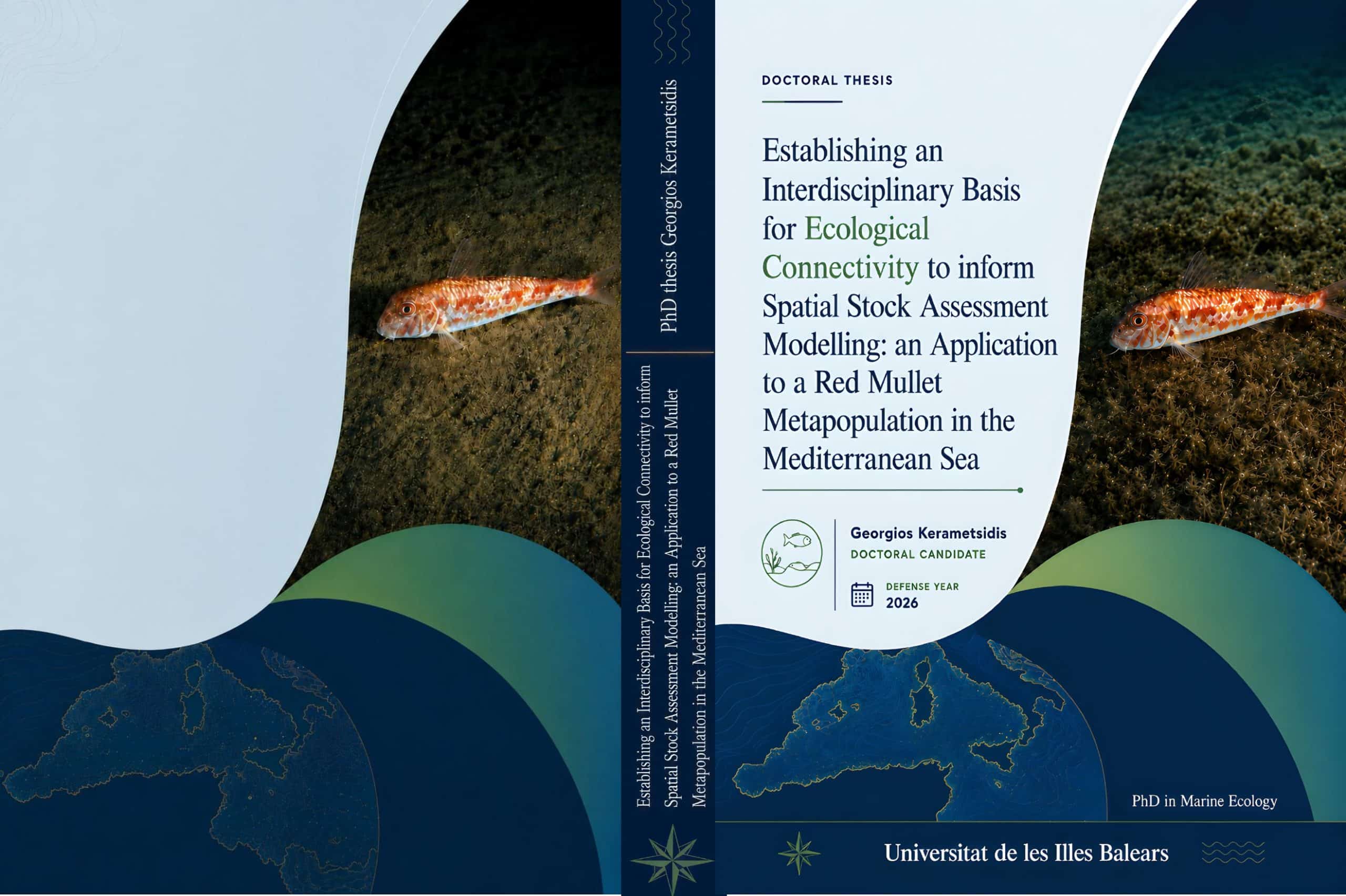
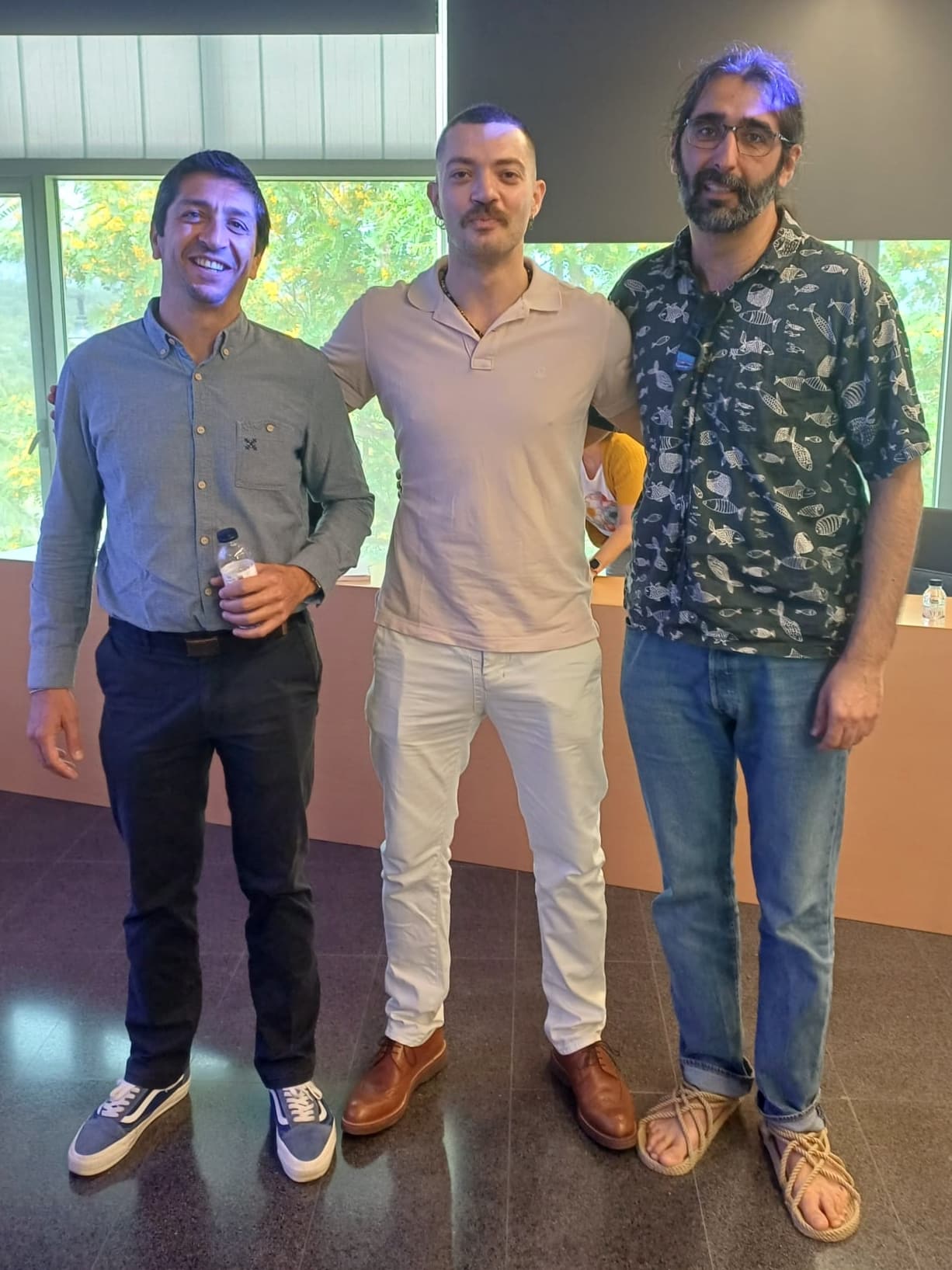
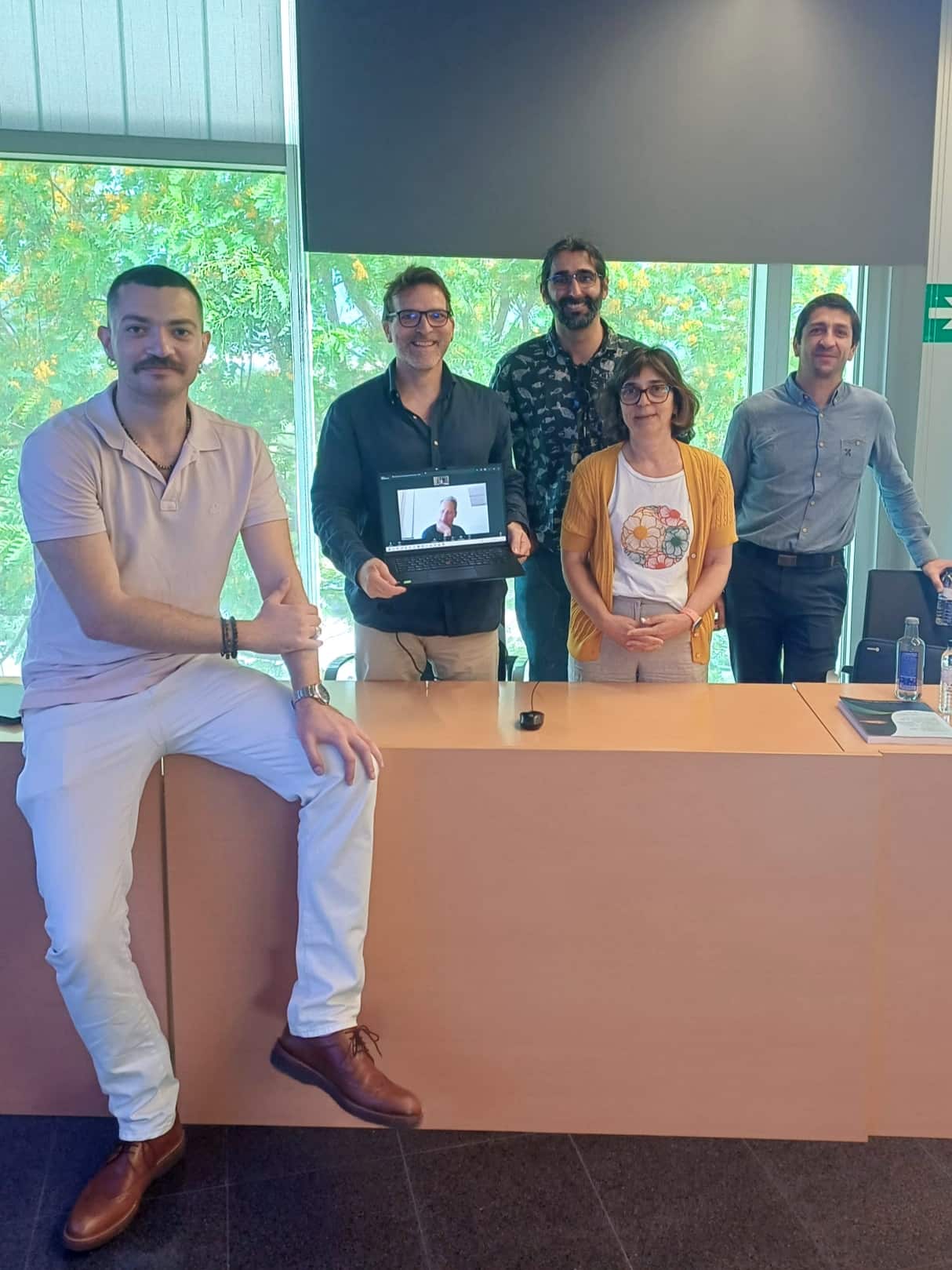
Georgios Kerametsidis, Balearic Oceanographic Centre (COB) – Spanish Institute of Oceanography (IEO), Spanish National Research Council (CSIC), defended his thesis on Friday 5 June 2026 at the University of the Balearic Islands (UIB) on the following topic: Establishing an interdisciplinary framework for ecological connectivity to inform spatial stock assessment modelling: an application to a red mullet metapopulation in the Mediterranean Sea.
He obtained the reference " cum laude ".
Members of the Jury
Chairman : Dr Alexandra Silva, Fisheries Resources Department, Portuguese Institute of the Sea and the Atmosphere (IPMA), Portugal
Supporting : Dr Evangelos Tzanatos, University of Patras, Greece
Secretary : Dr Ignacio Alberto Catalán Alemany, Marine Research in Ecological and Social Systems (IMSES), Mediterranean Institute for Advanced Studies (IMEDEA)
Co-supervisors:
- Manuel Hidalgo, Balearic Islands Oceanographic Centre – Spanish Institute of Oceanography (COB-IEO), Spanish National Research Council (CSIC)
- Vincent Rossi, Mediterranean Institute of Oceanography (MIO) – French National Centre for Scientific Research (CNRS), Aix-Marseille University.
Abstract
Effective sustainable management of marine resources and biologically realistic assessments depend on accurately identifying stock structure, including not only its external boundaries but also the spatial complexity within. However, most commercially harvested marine species are assessed on the basis of the long-standing assumption of a “stock unit” within prescribed boundaries known as assessment units.
This approach persists despite growing evidence of passive and active dispersal documented in a wide range of species across multiple spatiotemporal scales, both within and across stock boundaries. The main challenges in developing spatially explicit stock assessment models are:
- describing the most biologically plausible spatial stock structure, and
- obtaining robust, meaningful connectivity estimates, and then determining how to effectively integrate these data to model spatial dynamics.
Whilst tagging is a valuable method for quantifying connectivity in adult stages, it has clear limitations when it comes to understanding the dispersal of early-life stages, despite the proven influence it has on recruitment and spatial structure. In this PhD thesis, we adopted an interdisciplinary approach by integrating a spatiotemporal model, oceanographic simulations, and chemical and morphological markers to investigate the demographic connectivity and population spatial structure of one of the most important demersal species for Mediterranean fisheries, the red mullet (Mullus barbatus), across multiple scales and throughout its entire life cycle in the western Mediterranean Sea.
First, we hypothesised that the spatiotemporal variability in density within two adjacent stock units (i.e. GSA06 and GSA07) is associated with spatially structured environmental processes across multiple spatiotemporal scales. To test this, we applied a generalised empirical orthogonal function and dynamic factor analysis to fishery-independent and -dependent data for red mullet, a highly commercial species, in the western Mediterranean Sea. Areas with persistent and dynamic high aggregations were detected for both stock units. A large-scale climatic index and local open-ocean convection were associated with both stocks, whilst other variables exhibited stock-specific effects. We also revealed spatially structured density dynamics within the examined management units.
Later, we combined simulated larval dispersal modelling with tissue stable isotope analysis to investigate whether early-life dispersal connectivity persists into adulthood (i.e. is reflected in the stable isotope signatures of adult individuals). We observed a mismatch between the current “closed” assessment units and the identified biologically informed units. The identified metapopulation system comprises northern and southern subpopulations with distinct demographic roles. This stems principally from larval transport via the Northern Current from high-density, persistent spawning grounds and, secondarily, likely from regional differences in the isotopic baseline associated with different productivity regimes.
Finally, we integrated otolith trace element analysis—focusing specifically on elements whose concentrations are directly influenced by ambient water chemistry—with wavelet-based contour analysis across three spatial scales. A high (>70%) classification success rate was achieved for specimens grouped according to the spatial scale of the current assessment framework, and a moderate classification success rate (up to 60%) was achieved when specimens were grouped according to the more biologically realistic spatial ecoregions. Unsupervised classification based on trace elements revealed two distinct natal sources, whilst wavelet-based analysis identified seven morphotypes within the metapopulation system. Our findings are primarily explained by high dispersal during early life stages, the overall spatial uniformity of environmentally influenced chemical markers, and the presence of distinct, environment- and diet-driven spatial units.
After obtaining the necessary connectivity data, we developed a spatially explicit simulation-estimation framework for the red mullet metapopulation system in the north-western Mediterranean Sea, which was based on connectivity data (primarily) derived from simulated larval dispersal, a key driver of spatial dynamics for the species. The metapopulation system consisted of four interconnected subpopulations spanning two assessment units—GSA07 (Gulf of Lion) and GSA06 (Catalan Coast, Gulf of Valencia, Gulf of Alicante)—which are currently considered unconnected under the existing framework.
Various assessment (estimation) models—each representing different assumptions regarding connectivity and spatial stock structure—were fitted to simulated “observed” pseudo-data from the operating model under a range of underlying true spatial dynamics. The estimated parameters were subsequently compared with the true values used in the operating model, allowing us to evaluate the accuracy and potential biases of different assessment models. Across different model scenarios, recruitment estimates exhibited substantial bias when larval movement was ignored or stock structure was simplified compared to the OM. In the Gulf of Lion, recruitment was consistently underestimated by more than 50%, whilst, in contrast, the Catalan Coast showed an equally high overestimation of recruitment.
Our research highlights the importance of spatial stock assessment frameworks and the spatial dynamics of early life stages, which remain largely under-represented in operational fisheries management.