



Eleonord Mayissah Moungues (Masuku University of Science and Technology (USTM Gabo) – MIO University of Toulon) defended his doctoral thesis on Friday 17 July 2026 à 14h00 at the University of Toulon – La Garde Campus, on the following topic: Chemical and microbiological inputs from the Ogooué River into its mangroves.
Abstract
Sediments in rivers and mangroves act as an ecological reservoir, accumulating metals resulting from human activity (mining, industry, agriculture, towns and cities). But this sequestration is not permanent. When conditions change – such as climate, tides or dredging – these metals can be released into the water, contaminating fish and, ultimately, finding their way onto our plates.
In Gabon, the Ogooué River is precisely in this kind of situation: it rises in a mining area (manganese, gold), flows through rural and urban areas, and then empties into the Atlantic Ocean, feeding one of the largest mangrove forests in Central Africa. Throughout its course, human pressures vary and the river carries numerous sediment particles, which may be contaminated. However, whilst useful, the existing environmental monitoring relies mainly on satellite imagery and one-off chemical measurements, which only flag up damage once it is already visible.
This thesis proposes an alternative approach combining traditional geochemical indicators with the microbial communities living in sediments (bacteria, archaea); invisible to the naked eye, they are present in their billions in every gram of silt. These microorganisms react very quickly to changes in their environment: for example, if the concentration of a contaminant – particularly a metal – increases, some microorganisms disappear whilst others proliferate. Monitoring these changes in microbial communities would provide managers with an additional monitoring tool.
By studying three areas along the Ogooué River – the Franceville-Moanda mining region upstream, the main course of the Ogooué, and the mangroves of Port-Gentil on the coast, this study shows that combining geochemical and microbial indicators provides a much more detailed and earlier picture of the state of the ecosystems.
This thesis proposes practical tools for environmental managers, enabling them to anticipate environmental degradation rather than simply observing it. This approach can be applied to other countries facing the same challenges: reconciling economic development, resource extraction and the protection of natural heritage.
Key words
Ogooué River, Sediment, Trace metals, Geochemical indicators, Microbial biodiversity, Mangroves.
Composition of the jury
Mr Nicolas Marmier, University Professor, Université Côte d’Azur (France), Rapporteur,
Mr Olivier Gros, University Professor, University of the Antilles (France), Rapporteur,
Mr Alain Dolla, Research Director, CNRS (France), Examiner,
Mr Louis-Clément Obame Engonga, University Professor, Masuku University of Science and Technology (Gabon), Examiner,
Ms Isabelle Navarro, Research Fellow, IRD (France), Examiner,
Ms Estelle Dumont, Assistant Lecturer at the University of Science and Technology of Masuku (Gabon), Co-supervisor of a PhD thesis,
Mr Joseph Privat Ondo, Senior Lecturer (HDR), Masuku University of Science and Technology (Gabon), Co-supervisor of a PhD thesis,
Mr Stéphane Mounier, Senior Lecturer (HDR), University of Toulon (France), PhD supervisor.
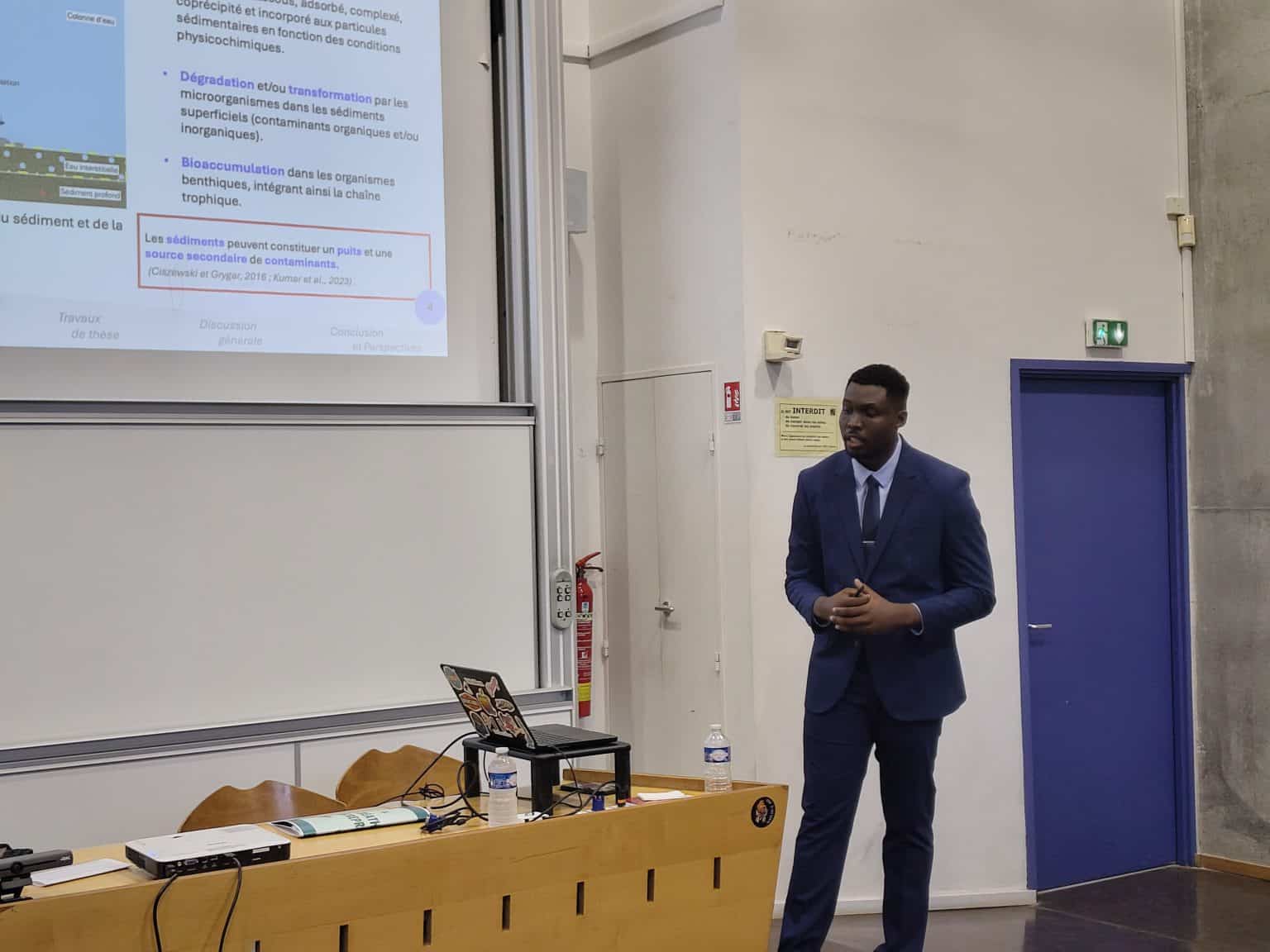
Photo credit: Stéphane Mounier